


Fall Risk and Predictive Movement Data: Turning Assessments Into Early Warnings
Fall Risk and Predictive Movement Data: Turning Assessments Into Early Warnings
Falls remain one of the most dangerous and costly events in healthcare, particularly among older adults and patients with neurological conditions. Despite decades of awareness, most fall prevention programs still rely on annual screenings and subjective risk questionnaires that miss the subtle changes happening between visits.
The problem is timing. By the time a patient presents with a fall, the window for intervention has already closed. What clinicians need is the ability to detect deterioration before it becomes a crisis.
Objective movement analysis makes this possible. By tracking metrics like postural sway, stride variability, and sit-to-stand transition times over multiple sessions, clinicians can identify downward trends that are invisible to the naked eye. A slight increase in gait asymmetry or a gradual decline in balance scores becomes an actionable signal — not just a data point.
At Kinetically, our platform is designed to surface these patterns automatically, giving providers the early warnings they need to adjust treatment plans, modify home environments, or escalate care before a fall occurs.
Prediction isn’t about replacing clinical intuition. It’s about giving clinicians the quantified evidence to act on what they already suspect — sooner.
Reducing Clinician Burnout: How Automated Movement Analysis Gives Time Back to Providers
Reducing Clinician Burnout: How Automated Movement Analysis Gives Time Back to Providers
Clinician burnout is a growing crisis across rehabilitation and neurology practices. A major contributor? The hours spent on manual documentation that pulls providers away from direct patient care.
For every patient encounter, clinicians are expected to record detailed functional assessments, track progress against baselines, and justify medical necessity — often through free-text notes that are time-consuming and inconsistent. The administrative weight is unsustainable, and it’s driving talented professionals out of the field.
Automated movement analysis offers a meaningful solution. When objective motion data is captured during standard clinical assessments, documentation practically writes itself. Metrics like joint range of motion, gait velocity, and balance scores are recorded in real time — no manual transcription required.
This isn’t about replacing clinical judgment. It’s about removing the documentation burden so clinicians can focus on what they trained to do: treat patients. When a platform like Kinetically generates quantified movement reports automatically, providers spend less time charting and more time caring.
The result is better documentation, better outcomes, and providers who can sustain long, fulfilling careers in patient care.
The Documentation Gap: How Objective Motion Data is Solving Clinicians Reimbursement Crisis
The Documentation Gap: How Objective Motion Data is trying to help in Solving Clinician's Reimbursement Crisis
Clinicians are facing an uncomfortable reality: claim denials are rising, and the culprit is often documentation that payers deem “insufficient.” The challenge isn’t the quality of care being delivered—it’s proving that care with the kind of objective evidence insurers now demand.
Traditional clinical notes rely on subjective language. Phrases like “patient is improving” or “moderate functional limitation” leave room for interpretation—and denial. Payers increasingly require quantifiable metrics that demonstrate medical necessity, track measurable progress, and justify continued treatment.
This is where objective motion analysis changes the equation.
By capturing precise movement data during assessments like the Timed Up and Go test, gait analysis, or balance evaluations, clinicians can document functional limitations with numbers, not narratives. A patient’s stride length, postural sway, or movement velocity becomes part of the clinical record—data that’s reproducible, defensible, and difficult to dispute.
For Clinicians, this represents more than a documentation upgrade. It’s revenue protection. When every visit generates objective metrics, the case for medical necessity builds itself. ADR requests decrease. Appeals become winnable. Skilled therapy services get the reimbursement they deserve.
At Kinetically, we believe clinicians shouldn’t have to fight for fair payment. Our platform transforms standard assessments into quantified evidence that speaks the language payers understand—giving agencies the documentation backbone they need to focus on what matters most: patient care.

Beyond the Clinic Visit: How Remote Movement Assessment is Changing the Patient-Provider Relationship
Beyond the Clinic Visit: How Remote Movement Assessment is Changing the Patient-Provider Relationship
The traditional model of neurological care follows a familiar pattern: patients arrive for scheduled appointments, clinicians assess their current state, and everyone hopes nothing significant changes before the next visit. For patients living with Parkinson’s disease or other movement disorders, those gaps between appointments can feel like navigating alone—weeks or months where symptoms fluctuate without clinical insight or guidance.
Remote movement assessment fundamentally shifts this dynamic. When patients capture their own movement data at home, they become active participants in their care rather than passive subjects of periodic evaluation. This contribution matters—not just clinically, but emotionally. Patients report feeling seen and heard when their daily experience is reflected in objective data their care team actually reviews.
The psychological impact shouldn’t be underestimated. Movement disorders often create a sense of losing control over one’s own body. When patients can document their symptoms objectively and share that information with their providers, they regain a measure of agency. The data validates what they’re experiencing, replacing the frustration of trying to describe symptoms that may not manifest during a brief clinic visit.
For providers, the change is equally profound. Instead of asking “how have you been?” and relying on memory and perception, clinicians can say “I noticed your gait variability increased last week—let’s talk about what was happening.” This proactive approach builds trust and demonstrates genuine attention to each patient’s journey. It transforms follow-up appointments from status checks into focused conversations about meaningful changes.
The relationship evolves from episodic encounters to continuous partnership. Providers can intervene earlier when data suggests declining function, reaching out before small changes become significant setbacks. Patients feel supported knowing their care team maintains visibility into their daily reality, not just their best performance in a clinical setting.
Care becomes collaborative, responsive, and grounded in shared information. The old model asked patients to report back if something went wrong. The new model says something far more powerful: “We’re watching together—and we’ll respond together when it matters most.”

Why MDS-UPDRS Alignment Matters: Bridging Technology and Clinical Standards in Parkinson's Assessment
Why MDS-UPDRS Alignment Matters: Bridging Technology and Clinical Standards in Parkinson's Assessment
Movement disorder specialists have long relied on the MDS-UPDRS as the gold standard for evaluating Parkinson’s disease severity and progression. Developed by the Movement Disorder Society, this comprehensive rating scale provides a structured framework for assessing motor and non-motor symptoms across multiple domains. Yet the subjective nature of these assessments—performed during brief clinic visits spaced weeks or months apart—leaves gaps that technology can now address. The question isn’t whether to adopt objective measurement tools, but whether those tools speak the same clinical language that guides treatment decisions.
The challenge with traditional assessment lies in its episodic nature. A patient’s motor function during a twenty-minute appointment may not represent their typical daily experience. Medication timing, stress, fatigue, and the unfamiliar clinical environment all influence performance. Clinicians have always understood this limitation, compensating with careful history-taking and patient diaries. But these workarounds introduce their own subjectivity, relying on patient recall and self-perception that may not capture the nuanced fluctuations that matter most for treatment optimization.
When assessment technology aligns directly with MDS-UPDRS constructs, it transforms from a data collection device into a clinical decision support system. Metrics mapped to bradykinesia severity, tremor amplitude, gait parameters, and postural stability don’t require translation or interpretation—they integrate naturally into the evaluation framework clinicians already use. This alignment eliminates the cognitive burden of reconciling novel measurements with established clinical meaning. A clinician reviewing objective data can immediately contextualize findings within the scoring system they’ve used throughout their training and practice.
Consider the specific domains where alignment delivers the greatest value. Bradykinesia assessment under the MDS-UPDRS examines movement speed, amplitude, hesitations, and decrement patterns across multiple tasks. Technology that quantifies these same parameters—finger tapping frequency decay, hand movement velocity reduction, pronation-supination rhythm irregularities—provides data that directly informs Items 3.4 through 3.8. Rather than generating abstract movement scores, aligned metrics answer the specific questions the MDS-UPDRS was designed to address.
Gait and postural assessment present similar opportunities. The MDS-UPDRS evaluates arising from a chair, gait characteristics, freezing episodes, and postural stability through Items 3.9 through 3.12. Objective measurement tools can capture stride length variability, step timing asymmetry, turn hesitation duration, and center-of-mass displacement with precision that exceeds visual observation. When these measurements map to the clinical constructs being evaluated, they enhance rather than complicate the assessment process.
Consider medication titration and DBS programming, where precision matters most. A general activity score provides limited guidance, but quantified bradykinesia measurements that correspond to MDS-UPDRS Item 3.4 offer actionable insight. Tracking how movement speed and amplitude respond to levodopa adjustments or stimulation parameter changes becomes systematic rather than impressionistic. Clinicians can identify optimal therapeutic windows and detect wearing-off patterns with the specificity that complex medication regimens demand. For patients on multiple daily doses with fluctuating motor states, this granularity transforms treatment from art to science.
Deep brain stimulation programming exemplifies the value of precision measurement. Neurologists adjusting stimulation parameters must balance therapeutic benefit against side effects, often making incremental changes across multiple programming sessions. Objective data showing how specific parameter adjustments affect bradykinesia severity, tremor amplitude, or gait stability accelerates the optimization process. Rather than waiting weeks to assess subjective patient reports, clinicians can observe quantified responses that guide subsequent adjustments with confidence.
The value extends beyond individual patient encounters. When longitudinal data follows standardized MDS-UPDRS domains, it creates a coherent record of disease trajectory that supports care transitions, specialist consultations, and research participation. Patients benefit from continuity; clinicians benefit from comparability; and the broader field benefits from data that can contribute to understanding disease progression at scale. A patient transferring between providers carries not just clinical notes but objective measurement history that any movement disorder specialist can interpret within the familiar MDS-UPDRS framework.
Research applications multiply when assessment data aligns with established standards. Clinical trials evaluating new therapeutics require outcome measures that regulatory agencies recognize and the scientific community accepts. MDS-UPDRS scores have served this purpose for decades, but their subjective components introduce variability that can obscure treatment effects. Objective measurements mapped to the same constructs reduce noise while maintaining clinical relevance. Smaller trials can detect meaningful differences; larger trials can achieve greater precision in characterizing therapeutic benefit.
The regulatory landscape increasingly favors this approach. As digital health technologies mature, FDA guidance emphasizes the importance of clinical validation and meaningful endpoints. Assessment tools that generate proprietary metrics face scrutiny about clinical significance—what does a “movement quality score” actually mean for patient care? Tools aligned with MDS-UPDRS constructs answer this question inherently. The clinical meaning is established; the technology provides more precise measurement of what clinicians already evaluate.
Technology that generates proprietary metrics may demonstrate technical sophistication, but clinical adoption depends on clinical relevance. Novel scoring systems require education, create interpretation burden, and risk becoming isolated data points disconnected from the broader clinical picture. By grounding objective measurement in the MDS-UPDRS framework, assessment tools become extensions of clinical expertise rather than parallel systems requiring reconciliation. The learning curve flattens because the conceptual framework remains familiar.
The goal isn’t to replace clinical judgment—it’s to arm clinicians with precision data that enhances the evaluations they’re already trained to perform. A movement disorder specialist’s expertise lies in synthesizing complex information into treatment decisions. Objective measurement aligned with MDS-UPDRS constructs provides richer input without demanding new interpretive frameworks. The technology serves the clinician; the clinician serves the patient; and the patient benefits from care guided by both human expertise and quantified precision.
As Parkinson’s care continues evolving toward personalized medicine, the tools that support clinical decision-making must evolve as well. Alignment with MDS-UPDRS isn’t a technical constraint—it’s a design philosophy that prioritizes clinical utility over technological novelty. The most sophisticated algorithm means little if its output doesn’t inform the decisions clinicians face daily. By speaking the established language of movement disorder assessment, objective measurement technology earns its place in the clinical workflow and delivers value that both patients and providers can recognize.

Catching Change Early: The Role of Continuous Monitoring in Movement Disorders
Catching Change Early: The Role of Continuous Monitoring in Movement Disorders
Neurodegenerative conditions rarely announce themselves dramatically. Parkinson’s disease, for example, may progress for years before symptoms become clinically apparent. By the time patients seek care, significant neurological changes have already occurred. This reality makes early detection not just valuable—but essential for preserving function and quality of life.
Continuous monitoring technology captures the variability that episodic clinic visits miss. A patient’s movement patterns fluctuate throughout the day, across medication cycles, and in response to fatigue or stress. Single assessments cannot capture this complexity, but longitudinal data reveals patterns that inform better treatment decisions and enable proactive rather than reactive care.
Remote assessment also brings clinical insight into patients’ real-world environments. How someone moves in a clinic corridor differs from navigating their own home. Technology bridges this gap, providing functional data from where patients actually live—the movements that matter most for maintaining independence.
For healthcare organizations, adopting continuous monitoring capabilities represents a competitive advantage. Patients increasingly expect their providers to leverage technology for better outcomes. Practices that offer sophisticated movement tracking demonstrate commitment to innovation while building stronger patient relationships through more personalized, data-informed care that catches problems before they become crises.
The Future of Patient Care
The future of patient care
Why Motion Analysis Matters Movement tells a story. For healthcare providers, the way a patient walks, stands, or performs everyday tasks can reveal critical insights about their neurological health, fall risk, and disease progression that traditional examinations might miss. Beyond the Snapshot Assessment Traditional clinical evaluations capture a moment in time. A patient visits their provider, performs a few movements, and receives feedback based on subjective observation. But what happens between visits? How do subtle changes in gait or balance develop over weeks or months? Motion analysis transforms episodic care into continuous insight. By objectively measuring movement patterns, clinicians can detect early warning signs of conditions like Parkinson’s disease, track rehabilitation progress with precision, and make data-driven decisions about treatment plans.
The Clinical Impact Research consistently demonstrates that quantitative movement assessment improves patient outcomes. Studies show that gait speed alone is a powerful predictor of fall risk, hospitalization, and even mortality in older adults. When clinicians can measure step length, cadence, symmetry, and balance with precision, they gain a clearer picture of their patients’ functional status. For patients managing chronic conditions, this means more personalized care. Rather than relying solely on self-reported symptoms or periodic office visits, providers can monitor meaningful changes and adjust interventions proactively. Empowering Better Decisions The goal of motion analysis isn’t to replace clinical judgment—it’s to enhance it. When healthcare providers have access to objective, longitudinal movement data, they can identify trends earlier, communicate more effectively with patients about their progress, and coordinate care with greater confidence. As healthcare continues evolving toward value-based, patient-centered models, tools that provide actionable movement insights will become essential. The patients who benefit most will be those whose providers embrace this evolution in clinical assessment.
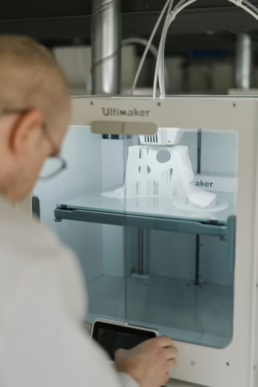
The Advantage of Clinical-Grade Measurement Tools for Movement Disorders
The Advantage of Clinical-Grade Measurement Tools for Movement Disorders
Not all movement assessment is created equal. Consumer fitness trackers and smartphone sensors can provide general activity data, but when clinical decisions depend on measurement accuracy, healthcare providers need tools designed to meet rigorous standards. The difference between consumer-grade and clinical-grade assessment can mean the difference between detecting meaningful change and missing it entirely.
Clinical-grade measurement tools undergo validation against established assessment methods, demonstrating their ability to accurately capture the specific movement parameters that matter for neurological conditions. This validation provides confidence that the data driving treatment decisions reflects true patient status rather than sensor noise or algorithmic artifacts.
Precision matters profoundly in movement disorders. A tremor frequency shift of 0.5 Hz or a stride length change of two centimeters can carry clinical significance—changes that consumer devices may not reliably detect or may report inconsistently. Clinical-grade tools are engineered to capture these subtle variations with the reproducibility that healthcare decisions require.
Regulatory considerations add another dimension. As movement data increasingly informs care plans and reimbursement documentation, healthcare organizations need confidence that their assessment tools meet applicable standards. Clinical-grade solutions provide the documentation, validation data, and quality systems that support defensible clinical practice.
For healthcare providers serious about integrating movement analysis into neurological care, clinical-grade tools aren’t a luxury—they’re the foundation of credible, actionable assessment that patients and payers can trust.
How AI is Empowering Researchers in Movement Disorder Science
How AI is Empowering Researchers in Movement Disorder Science
The study of movement disorders has long been constrained by the limitations of human observation. Researchers analyzing gait patterns or tremor characteristics relied on frame-by-frame video review—a painstaking process that limited study sizes and introduced observer bias. Artificial intelligence is fundamentally changing what’s possible.
Machine learning algorithms can now process movement data at scales previously unimaginable. What once took a research team weeks to analyze can be completed in hours, with consistency no human observer could maintain across thousands of data points. This acceleration doesn’t just save time—it opens entirely new avenues of investigation.
AI excels at pattern recognition across large datasets, identifying subtle correlations between movement characteristics and clinical outcomes that might escape even experienced researchers. These insights can reveal early biomarkers of disease, predict treatment response, and stratify patients for clinical trials with unprecedented precision.
Perhaps most significantly, AI enables longitudinal analysis at population scale. Researchers can track movement changes across diverse patient groups over extended periods, building evidence bases that inform clinical guidelines and therapeutic development. The algorithms improve continuously, learning from each new dataset to refine their analytical capabilities.
For the movement disorder research community, AI represents more than efficiency—it represents the possibility of discoveries that were simply inaccessible before. Institutions embracing these capabilities position themselves to lead the next generation of neurological research and translate findings into better patient care faster than ever before.
From Subjective to Objective: How Technology is Transforming Neurological Assessment
How Technology is Transforming Neurological Assessment
For decades, clinicians have relied on rating scales and visual observation to assess movement disorders. While these methods provide valuable clinical insight, they carry inherent limitations: two providers watching the same patient may score differently, and subtle changes between visits often go undetected. This variability creates challenges for tracking disease progression and evaluating treatment effectiveness.
Technology changes this equation. Modern motion analysis captures data points invisible to the human eye—tremor frequencies measured in hertz, stride length variations of millimeters, balance shifts occurring in fractions of a second. These precise measurements create objective baselines that remove guesswork from follow-up assessments and enable clinicians to detect meaningful changes earlier.
The clinical value extends beyond individual visits. When a patient’s gait symmetry decreases by 8% over three months, that quantifiable change drives meaningful conversations about disease progression or treatment adjustments. Standardized measurements also enable clearer communication between specialists, physical therapists, and primary care providers—everyone working from the same objective data rather than interpreting subjective notes.
Healthcare systems investing in objective movement assessment position themselves at the forefront of neurological care. As reimbursement models increasingly reward outcomes over volume, the ability to demonstrate measurable patient improvement becomes not just clinically valuable, but financially essential.