
News & Insights.
Clinical perspectives, practical guides, and what we're learning alongside the clinicians who use Kinetically.
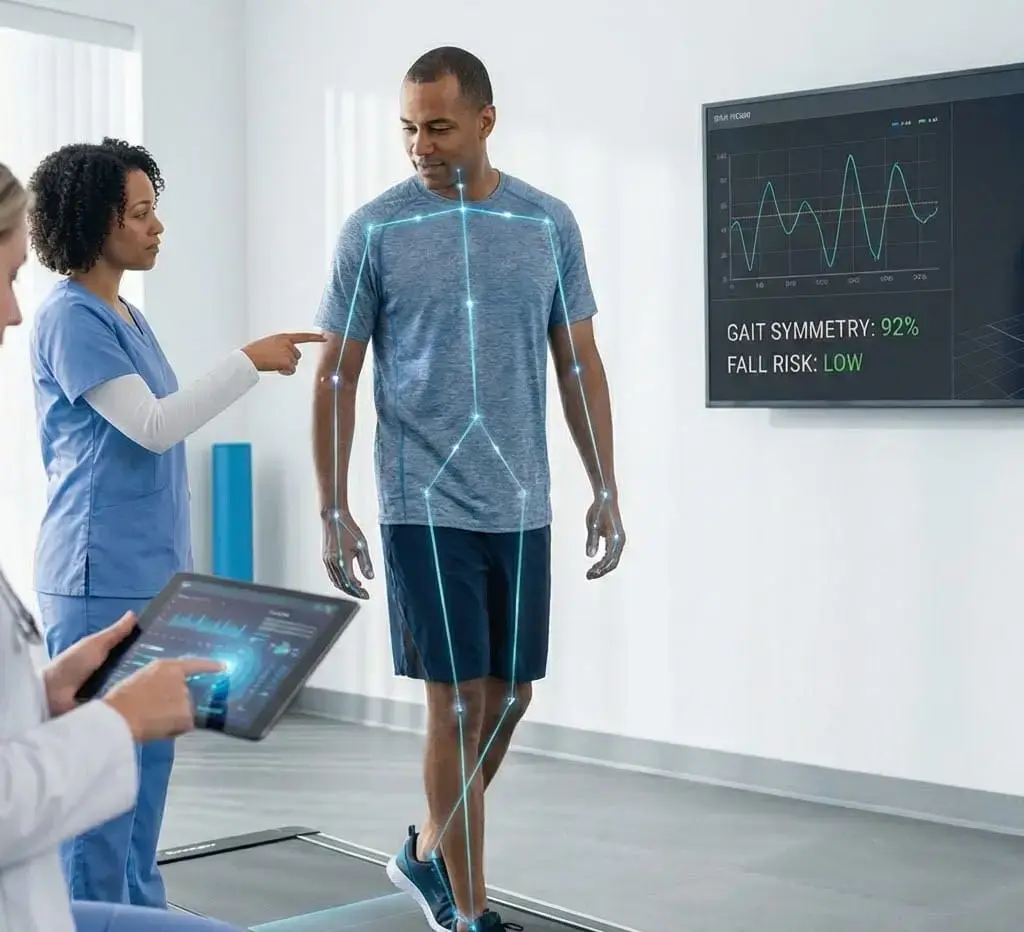 Clinical
Measuring Movement Asymmetry: What Left–Right Differences Reveal
Side-to-side differences in how the body moves often signal a problem—or recovery—before a global score does. The catch is measuring them consistently.
Read article →The Shift Toward Objective Measurement in Rehab
Across rehabilitation and movement-focused care, a quiet shift is underway — from describing movement to measuring it. Here's why it's accelerating.
TechnologyData Privacy in Digital Movement Assessment
Moving movement analysis onto everyday devices raises a fair question: what happens to the data? Privacy has to be part of the design, not an afterthought.
ClinicalSit-to-Stand: A Window into Lower-Limb Function
Rising from a chair is something most people do without thinking. How they do it reveals a surprising amount about strength, balance, and function.
ClinicalFall Risk and Predictive Movement Data: Turning Assessments Into Early Warnings
Falls remain one of the most dangerous and costly events in healthcare — and objective movement analysis can detect deterioration before it becomes a crisis.
WorkflowReducing Clinician Burnout: How Automated Movement Analysis Gives Time Back to Providers
Hours spent on manual documentation pull providers away from patient care. Automated movement analysis offers a meaningful solution.
ReimbursementThe Documentation Gap: How Objective Motion Data is Solving Clinicians' Reimbursement Crisis
Claim denials are rising because of documentation payers deem 'insufficient.' Objective motion data is changing the equation.
Patient CareBeyond the Clinic Visit: How Remote Movement Assessment is Changing the Patient–Provider Relationship
When patients capture their own movement data at home, they become active participants in their care — and care becomes a continuous partnership.
Clinical StandardsWhy MDS-UPDRS Alignment Matters: Bridging Technology and Clinical Standards in Parkinson's Assessment
When assessment technology aligns with MDS-UPDRS constructs, it stops being a data collection device and becomes a clinical decision support system.
MonitoringCatching Change Early: The Role of Continuous Monitoring in Movement Disorders
Neurodegenerative conditions rarely announce themselves dramatically. Continuous monitoring captures the variability that episodic clinic visits miss.
IndustryThe Future of Patient Care
Movement tells a story. For healthcare providers, the way a patient walks, stands, or performs everyday tasks can reveal critical insights traditional exams miss.
TechnologyThe Advantage of Clinical-Grade Measurement Tools for Movement Disorders
When clinical decisions depend on measurement accuracy, healthcare providers need tools designed to meet rigorous standards — not consumer-grade sensors.
ResearchHow AI is Empowering Researchers in Movement Disorder Science
Machine learning processes movement data at scales previously unimaginable, opening entirely new avenues of investigation.
ClinicalFrom Subjective to Objective: How Technology is Transforming Neurological Assessment
Motion analysis captures data points invisible to the human eye — tremor in hertz, stride in millimeters, balance in fractions of a second.
WorkflowRange of Motion Without a Goniometer
The goniometer has measured joint motion for a century. Markerless capture offers a faster, more repeatable way to get the same kind of number.
ClinicalQuantifying Tremor Beyond Visual Rating
Tremor is usually rated by watching and assigning a score. Objective measurement can capture what the eye approximates — amplitude, frequency, and change over time.
IndustryWhy Value-Based Care Needs Objective Movement Data
As healthcare shifts from paying for volume to paying for outcomes, the ability to actually measure those outcomes stops being optional.
Patient CareClosing the Home Exercise Adherence Gap
Most rehabilitation happens between visits, in the exercises a patient does at home. The trouble is that no one can see those exercises — until now.
ClinicalThe Timed Up & Go Test, Modernized
The Timed Up & Go is one of the most widely used functional tests in the world. Objective capture can keep what makes it great while adding the detail a stopwatch can't.
TechnologyFrom the Motion Lab to the Bedside
The capabilities that once required a dedicated research lab are becoming portable. That shift changes who gets access to objective movement analysis.
Patient CareFunctional Outcomes That Matter to Patients
Patients don't measure recovery in degrees of motion. They measure it in stairs climbed and groceries carried. The best metrics connect the two.
ReimbursementRTM 101: Remote Therapeutic Monitoring for Rehab
Remote Therapeutic Monitoring gives rehab providers a way to track patients between visits — and to be recognized for the work it takes. Here's the plain-language version.
ClinicalMeasuring Balance and Postural Sway Objectively
Balance is easy to observe and hard to quantify. Objective measures of postural sway turn a subjective impression into something a clinician can track.
WorkflowStandardizing Assessments Across Your Clinic
When every clinician measures a little differently, the data never quite lines up. Standardization is what makes movement measurement comparable — across visits, providers, and locations.
ClinicalGait Velocity: The Sixth Vital Sign
How fast someone walks turns out to be one of the most informative numbers in a clinical encounter — when it's actually measured.
TechnologyWhat Is Markerless Motion Capture?
For decades, measuring movement precisely meant a lab full of cameras and reflective markers. Computer vision is changing what's possible — and where it can happen.
ClinicalThe Reliability Problem in Movement Assessment
Two clinicians can watch the same patient walk and score them differently. That variability is one of the oldest challenges in rehabilitation — and one of the most solvable.
See movement, measured.
Start free and turn a smartphone video into objective clinical metrics in minutes.